The Royal Arch is an integral part of what is described by the United Grand Lodge of England as "pure ancient Freemasonry", comprising the three Craft degrees and the Supreme Order of the Holy Royal Arch. These four stages form a continuous and unified journey of self-discovery, moral development, and enlightenment.
While Craft Masonry lays the foundation—establishing the importance of brotherly love, relief, and truth—the Royal Arch completes the story. It does so by answering questions left open in the Third Degree, particularly concerning the loss and recovery of ancient secrets. In this way, the Royal Arch does not stand apart from the Craft, but is intrinsically linked as its natural and essential completion.
An eternal bond of trust, respect, and shared light within the Royal Arch.
The Triple Tau — a key to deeper understanding and ancient truth.
Within these walls, the veils part to reveal the mysteries of the Arch.
Symbols of service, dedication, and the journey through the Arch degrees.
Historically, the Royal Arch has been practiced in England since at least the 18th century, and its ceremonial richness and deeper symbolism offer a fulfilling culmination to the Masonic journey begun in the Craft Lodge.
Just as no puzzle feels complete without all corners in place, so too does a Freemason’s personal development gain completeness and clarity through exaltation into the Royal Arch. Each element—each "piece"—builds upon the other, creating a fuller and brighter image of what it means to be a Freemason.
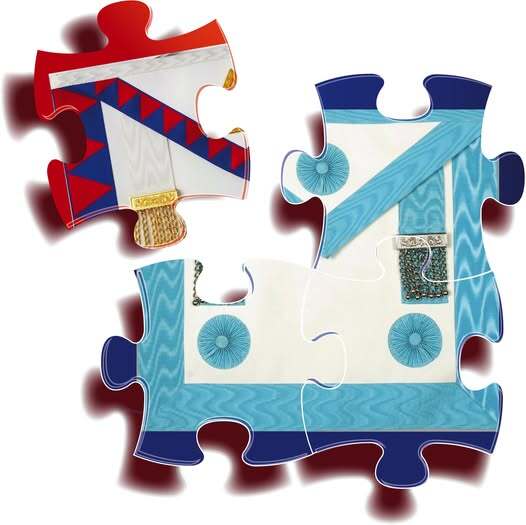
The image accompanying this section—a set of jigsaw puzzle pieces—illustrates this relationship. The Craft degrees can be viewed as the first three corners of a personal Masonic puzzle: Entered Apprentice, Fellowcraft, and Master Mason. The Royal Arch forms the fourth essential corner, bringing structure, symmetry, and a deeper understanding of the full Masonic picture.
In the early 18th century, Masonic practice in England was limited to two degrees: Entered Apprentice and Fellow Craft. This changed with the establishment of the first Grand Lodge in London in 1717, which saw the introduction and growing adoption of a third degree — that of Master Mason, marked by the Hiramic legend.
Yet, the third degree left an unresolved element — the loss of the true secrets — and thus, it seemed natural that an additional ceremony would emerge to complete the narrative. While the Master Mason degree focused on the building of King Solomon’s Temple, the new ritual extended the story to the era following the Babylonian exile, portraying the rediscovery of what had once been lost during the rebuilding of the Temple. This evolution gave rise to the Royal Arch.
Initially, this further ceremony was reserved for those who had presided as Worshipful Master of their Lodge, but by the mid-18th century, such restrictions eased. By the 1750s, the Royal Arch had grown in popularity and was more widely accessible.
In 1756, a schism occurred within English Freemasonry. A faction known as the Antients separated from the original Grand Lodge (which ironically became known as the Moderns). Among several differences, one of the most notable points of contention was the recognition of the Royal Arch. The Antients embraced it as a fourth degree and worked it within their Craft Lodges. The Moderns, while officially dismissing it, tolerated its practice outside of the Lodge framework, with many senior members quietly participating.
To address growing interest and use of this degree, Lord Blayney, then Grand Master of the Moderns, established a formal governing body on 22 July 1766. This new body was chartered to oversee Royal Arch workings and stipulated that only experienced Master Masons were eligible for exaltation. The resulting organization, named the Grand and Royal Chapter of the Royal Arch of Jerusalem, was the forerunner of today’s Supreme Grand Chapter of England. Among its founding signatories was Thomas Dunckerley, who would go on to serve as Grand Superintendent in both Hampshire and the Isle of Wight.
Over time, Chapters dedicated solely to the Royal Arch became the norm, with those leading the ceremonies adopting the title of "Principals" rather than Masters.
The divide between the Antients and Moderns was finally bridged in 1813 with the Act of Union, overseen by HRH the Duke of Sussex. This historic agreement brought about the formation of the United Grand Lodge of England (UGLE). A key element of the unification was the adoption of a compromise that declared:
“Pure Antient Masonry consists of three degrees and no more: Entered Apprentice, Fellow Craft, and Master Mason — including the Supreme Order of the Holy Royal Arch.”
This acknowledgment established the Royal Arch not as a separate fourth degree, but as the completion of the Master Mason journey. It remains a defining component of Pure Antient Freemasonry to this day.
The ritual of exaltation transports us to a point in history approximately five centuries after the original Temple of Solomon was dedicated. Solomon himself has long since passed, and Jerusalem has fallen to Babylonian forces. The Temple lies in ruins, and the Jewish people have spent 70 years in exile.
Now, history shifts. Babylon has fallen to Cyrus, King of Persia, who has issued a decree permitting the exiled Hebrews to return home.
As a candidate for exaltation, you will symbolically represent one of those exiles returning to the devastated city. You will be blindfolded, embodying a Sojourner — a builder seeking to aid in the reconstruction of what was lost and to discover deeper truths with your fellow craftsmen.
The Chapter room and its furnishings are designed to reflect this journey. Initially, the setting represents a construction site on the very ground where Solomon’s Temple once stood. You will symbolically traverse this area and arrive above what will be revealed as a hidden, vaulted chamber.
As the scene changes, the carpet and symbols on the floor come to represent the interior of this ancient vault — a place where, through your symbolic labour and that of your companions, a profound discovery awaits. This moment of rediscovery lies at the heart of the Royal Arch experience.